Ready to prove you can get stronger without a gym membership? This guide shows how simple bodyweight moves and yoga-style strength can build muscle, boost aerobic fitness, and help manage fat mass.
You don’t need equipment or a big space—just clear a spot in your living room or patio and start. Short beginner circuits of two sets of 10–15 reps with 30–60 seconds rest take about 15–20 minutes and fit into busy days.
You’ll get a practical roadmap with progressions from beginner to advanced, warm-up tips that protect your back and hips, and finishers that raise your heart rate safely. Follow the Physical Activity Guidelines by aiming for at least 150 minutes of moderate or 75 minutes of vigorous exercise each week.
This section prepares you to train smarter, not harder, with bodyweight options that create a true full-body workout while being gentle on joints. Turn this listicle into your quick go-to plan and start building strength today.
Why At-Home, No-Equipment Training Works for Women Over 35
You can build real strength and stamina using only your body and a few minutes each day. Bodyweight training effectively increases muscle mass, improves aerobic fitness, and helps manage fat mass without a fancy gym.
Short sessions measured in minutes create momentum. Two sets of simple moves take about 15–20 minutes and fit into busy schedules. Certified trainers remind you that your body supplies all the resistance you need.
Set up a small space with a mat so you have a clear spot to train. That cue makes it easier to switch into workout mode when you are working home or pressed for time.
- Start with accessible exercises and scale as they get easier.
- Focus on consistent sessions to protect your core, joints, and energy levels.
- Follow national targets: aim for 150 minutes moderate or 75 minutes vigorous weekly.
Use mindset cues—show up, press play, move your body—and lean on simple structure to keep progress steady. Consistency, not complexity, delivers the biggest gains.
Quick Warm-Up to Protect Joints, Back, and Hips
Open with a few mindful drills that set your posture, engage your core, and fire the glutes. This short warm-up wakes movement patterns and readies you for a safe session.
Bridge and Bird Dog to activate glutes and engage core
Start on the floor with Bridge. Lie on your back with knees bent and feet flat. Push through your feet, brace your core, and raise hips until fully extended. Squeeze your glutes, then lower with control.
Move into Bird Dog from all fours. Hands under shoulders, knees under hips. Extend the opposite arm and leg, pause 2 seconds, return and switch sides. Keep knees tracking and spine neutral.
Plank to Downward Dog to prep shoulders and hamstrings
Find a strong high plank position with hands under shoulders. Engage core and then pike hips up into Downward Dog, forming a triangle. Keep your neck neutral and gaze toward your feet.
- Use clear directions: neutral spine, ribs down, breathe steadily.
- Hold each position for controlled reps so muscles activate without rushing.
- Finish with one more plank-to-dog flow to sync shoulders and hips.
“A brief, focused warm-up protects your back and boosts movement quality.”
Home Workouts for Women: Beginner Full-Body Circuit
Use this focused circuit to train every major muscle in one efficient session. Complete two sets of each move with 10–15 reps and rest 30–60 seconds between exercises. The full routine wraps in roughly 15–20 minutes.
Structure: Two sets, steady pace
Chair Squat: Stand feet shoulder-width apart, hinge at the hips, sit back to touch a chair, then push through your heels to stand. Keep chest tall and knees tracking over the mid-foot.
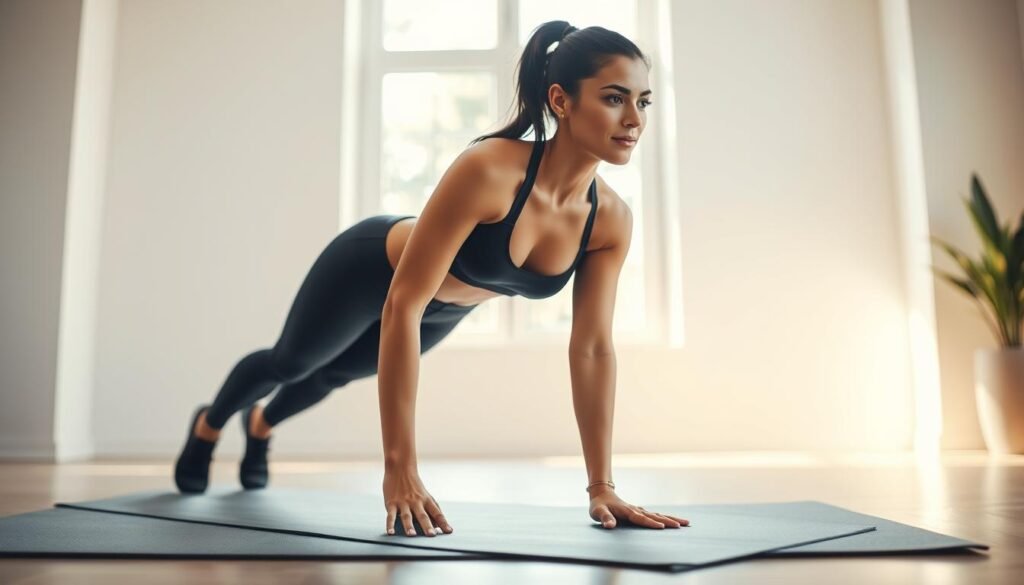
Knee Pushup: From a high plank on your knees, hold a straight line head to knees. Bend elbows to about 45° as you lower, then press back up. Stay in one strong position to build pressing confidence.
Moves to cycle through
Stationary Lunge: Split stance with the front foot flat and rear toes down. Lower until the front thigh is parallel, then drive through the front foot. Switch legs after each set.
Forearm Plank: Hold your body in a straight line from head to feet. Avoid sagging; aim for 30–60 seconds per set to train trunk control.
Bicycle Crunch: Lie tabletop, hands behind head. Alternate elbow-to-opposite-knee while extending the other leg with control.
- Follow the simple circuit: two sets, 10–15 reps, 30–60 seconds rest, about 15–20 minutes total.
- Pause between reps if needed; quality reps beat rushed ones every time.
- When 15 reps feel easy, add reps or a third round before moving up.
“Note your reps and how each move felt so you can progress predictably next session.”
Intermediate Bodyweight Circuit With Cardio Bursts
Mix steady strength sets and short cardio spikes to challenge your endurance and build power. This plan uses three mini-circuits with brief cardio after each block so you keep the heart rate up while building strength.
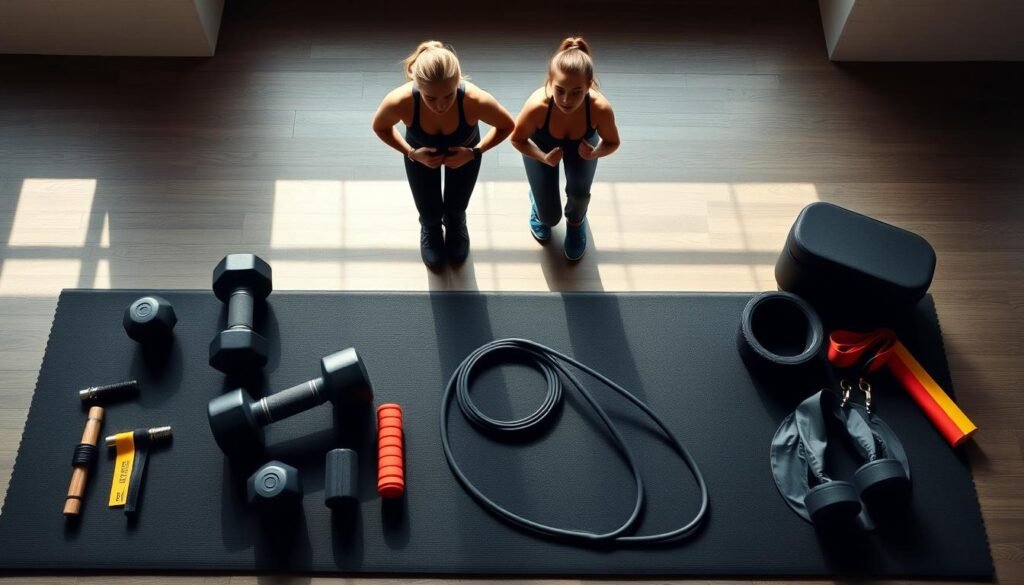
Structure: Complete 3–4 rounds. After each mini-circuit do 60 seconds of cardio, then rest 60 seconds. Modify rounds or seconds to match your current fitness.
Circuit breakdown
Circuit 1: Bodyweight squats (15), plank shoulder taps (20), cross jacks (45–60 seconds).
Circuit 2: Reverse lunge with knee drive (10 per leg), crab walk (20 steps), knee drives (10 per leg).
Circuit 3: Glute bridge (20), dead bug (20), butt kicks (45–60 seconds).
- Rotate through the three mini-circuits with a 60-second cardio burst to raise the pulse.
- Keep a solid plank during shoulder taps and avoid rocking the hips for better balance and core control.
- Train your legs with controlled lunges, using arm movement to aid balance and forward drive.
Directions: Choose a steady movement tempo so form stays sharp as fatigue builds. Track reps completed in each round and aim for small improvements next session. This routine fits neatly into a short home session when you want efficient, no-equipment progress.
Advanced Progressions When You’re Ready to Level Up
Advanced progressions combine stability, load shift, and explosive movement to test your gains. Move into these patterns after you can perform the basics with clean form.
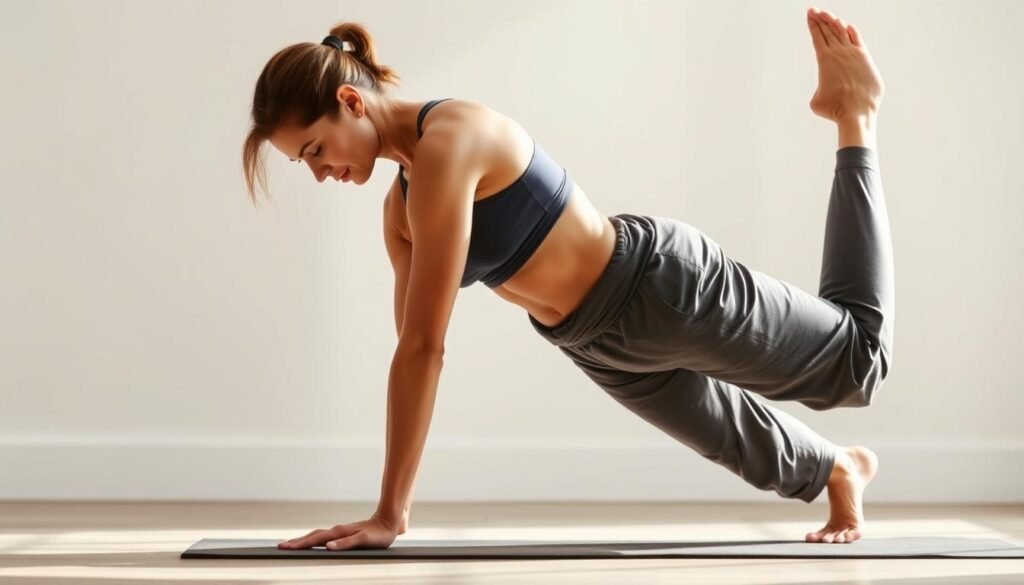
Single-leg bridge and overhead squat
Try the single-leg bridge with the raised leg fully extended and foot flexed. Perform equal reps on each leg to balance glute and hip strength.
Practice the overhead squat with arms locked overhead. Keep ribs down, sit between your hips, and use this to build mobility plus core strength.
One-legged pushup and elevated pike pushup
Progress to one-legged pushups to shift load to your upper body while your lifted leg challenges midline control. Elevate your feet for pike pushups to increase shoulder demand.
Jumping lunges and hollow hold to jackknife
Add short, seconds-based bursts of jumping lunges to develop power. Use the hollow hold to jackknife combo to train deep core control through the full range.
- Balance: Keep hips level and feet active as you alternate sides.
- Quality: Advance only when reps stay clean; stop if form breaks.
- Rotate: Split these moves across days so you recover fully.
- Record: Track times and reps to progress with purpose.
- Tempo: Use controlled seconds on the eccentric to protect joints.
- Prioritize equal leg development and controlled movement.
- Use elevated pike and one-legged pushups to increase upper-body strength.
- Keep sessions short and focused so you can repeat these advanced exercises safely.
Lower Body Focus: Legs and Glutes You Can Train Anywhere
Train your lower half with practical, repeatable exercises that improve balance and daily function. These moves target the large muscles that power walking, climbing stairs, and lifting. You can scale each pattern to match your current level.
Air, Sumo, and Tempo Squats
Start with air squats to groove hip and knee movement. Use a sumo stance to hit inner thighs and glutes.
Tempo squats slow the lowering phase so you load the muscles without adding weight. Focus on even pressure through the whole feet to protect knees and boost stability.
Front, Back, and Side Lunges; Step-Ups
Rotate front, back, and side lunges to build multi-directional control and better balance. Add jump lunges if you want power work.
Step-ups on a sturdy surface train single-leg strength and coordination. Hold a secure household weight like a detergent bottle to increase challenge safely.
Glute Bridge Variations
Glute bridges protect your lower back while strengthening hips. Progress from two-legged bridges to single-leg versions to target hamstrings, glute, and core.
Use bands if you have them, or keep sets succinct and repeatable so you train lower body consistently each week.
- Tip: Keep your knees tracking and feet grounded for better stability.
- Tip: Move with control, not speed, to feel legs versus glutes.
- Tip: Note where you feel each move and adjust stance or tempo to emphasize different muscles.
“Small, consistent lower-body work builds strength you use every day.”
For a full plan that fits busy schedules, check this helpful guide: fitness for women over 35.
Arms and Core on the Floor: Strength Without Weights
A simple mat and a few focused moves let you build stronger arms and a tighter core right on the floor.
Start with pushups or knee pushups to load the chest, shoulders, and triceps. Use knees or an elevated countertop if full pushups feel heavy. Stack shoulders over wrists and keep ribs tucked to protect your shoulders and spine.
Pushups and Knee Pushups
Keep elbows about 45 degrees and count quality reps. If wrists bother you, try pushups on fists or handles. Progress by lowering the surface until full-floor pushups feel manageable.
Planks and Side Planks
Hold a forearm plank and side plank to develop total-body stability. Short holds with tight form beat long sloppy ones. Add a few seconds each week to build endurance.
Shoulder Taps and Dead Bug
From a steady plank, add shoulder taps to train anti-rotation—do not let your hips sway. The dead bug teaches deep core control: lie supine, legs tabletop, extend opposite arm and leg while keeping the lower back flat.
- Use knee pushups on the floor to master pressing position.
- Hold front and side planks to engage your whole body.
- Count quality reps and stop one shy of failure to keep form crisp.
- Sprinkle these exercises at the end of lower- or full-body days to finish strong.
“Small, consistent floor work builds pressing strength and deep core stability.”
Full-Body Finishers to Boost Heart Rate and Burn
Finishers are short blasts that make a big metabolic impact. Use these to raise your effort at the end of a session and solidify gains from earlier strength work.
Burpees Tabata — 20 seconds on, 10 seconds off
Do 4–8 rounds of burpees Tabata style: 20 seconds maximal effort, 10 seconds rest. This bodyweight, full-body exercise drives up your heart rate fast.
Choose rounds based on how you feel and keep your chest up to protect the back. Track total reps per round to measure progress.
Mountain Climbers — pace to match your goal
Run mountain climbers quickly to tax cardio, or slow them to emphasize core control with controlled reps. Alternate tempos across rounds to vary stimulus.
Butt Kicks — a low-impact option
If you need less stress on joints, do butt kicks for 45–60 seconds. They keep time moving and still raise the pulse without heavy impact.
- Structure: pick 2–3 finishers and rotate across sessions.
- Protect form: brace your midline on every rep and stop while form stays clean.
- Timing tip: use clear seconds for work and rest so you focus on effort, not counting.
“Finishers should feel tough but manageable—track reps and respect your recovery.”
Your No-Equipment Weekly Plan and Time Targets
Plan your week around short, consistent sessions that hit both strength and cardio targets. Use clear time goals so each session has purpose and fits your schedule.
Weekly minutes: Aim for at least 150 minutes of moderate or 75 minutes of vigorous activity. That total guides how many short circuits you’ll schedule each week.
Sample schedule and structure
Beginner: two sets of 10–15 reps per exercise with 30–60 seconds rest. Each session takes ~15–20 minutes, so three sessions reliably add minutes toward your weekly target.
Intermediate: use timed circuit rounds. Do 3–4 rounds with 60-second cardio bursts and 60 seconds rest. This format raises intensity while keeping sessions predictable.
- Schedule 3–5 circuit days at home and include one legs-focused day to build strength.
- Track reps and exercises so you can increase load or rounds week to week.
- Add one short finisher day for conditioning without overloading recovery.
“Set a weekly target, keep rest consistent, and review your plan each Sunday.”
Setup, Space, and Safety Cues for Training at Home
Make your practice simple to start and safer to keep doing. Pick a consistent corner and lay down an exercise mat or towel as your cue. A dedicated spot reduces setup time and helps you show up more often.
Create a dedicated zone with a mat and clear floor
Set up a small, clear space so you can move without tripping. Keep a couple of household items nearby if you want optional weight instead of buying equipment.
Form tips: neutral spine, knees tracking, engage core, protect lower back
Follow simple directions each set: neutral spine, ribs stacked, shoulders down, breathe. Check that your knees track over toes and your feet stay rooted to protect the lower back.
Engage core before every rep to stabilize hips and back. Film a quick set now and then to confirm your position.
Smart progressions: add reps, seconds, or rounds without losing form
Increase reps, seconds, or rounds only when your last set stays sharp. If joints feel cranky, shorten the range, slow the tempo, or elevate hands for push variations.
- Set up: exercise mat ready so you start fast.
- Optional load: use detergent bottles as makeshift weight.
- Reset: shake out tension, sip water, check feet, knees, and hips before the next position.
“Train with confidence—consistency beats complexity.”
Conclusion
Conclusion
Wrap your plan with a clear routine that helps you turn minutes into measurable strength gains.
Use the simple blueprint: warm up, train with intent, and cool down briefly. Keep circuits short and repeatable so you can stack sessions and build strength across weeks.
Rotate lower body, arms and core work plus a few finishers to hit glutes, legs, hips, and plank patterns evenly. Track reps and minutes so progress is clear when you are working at home.
Stay form-first: check position, protect your lower back, and move with control on the floor. Add small progressions—more reps, extra seconds, or another circuit—only when your form stays clean.
Keep showing up: consistent workouts deliver the results you want. Use optional household weight sparingly; your bodyweight will take you far.
FAQ
What are the best no-equipment routines when you’re 35 or older?
Focus on full-body, bodyweight circuits that build strength, mobility, and aerobic fitness. Start with a beginner circuit—chair squats, knee push-ups, stationary lunges, forearm plank, bicycle crunches—and progress by adding rounds, seconds, or dynamic moves like reverse lunges and crab walk. Prioritize form, engage your core, and protect your lower back and knees.
How long should a quick warm-up take and which moves protect your joints?
Spend 5–8 minutes on a warm-up that activates glutes and stabilizers: bridges and bird dogs to engage glutes and core, then plank to downward dog to wake shoulders and hamstrings. These movements improve hip stability and reduce strain on the lower back during the workout.
How do you structure a beginner full-body circuit at home?
Use 2 sets of each move with 10–15 reps, resting 30–60 seconds between exercises. Aim for a 15–20 minute session total. Keep feet hip-width, maintain a neutral spine, and move with control to build strength and balance while minimizing injury risk.
What does an intermediate circuit with cardio bursts look like?
Try 3–4 rounds where each mini-circuit includes 3–4 strength moves (bodyweight squats, plank shoulder taps, cross jacks, reverse lunge to knee drive) followed by a 60-second cardio burst like knee drives or mountain climbers, then 60 seconds rest. This raises heart rate, improves endurance, and builds power.
When should you add advanced progressions and which ones work best?
Progress when you can complete intermediate rounds with solid form and minimal fatigue. Add single-leg bridge (leg extended), overhead squat variations, one-legged push-ups, elevated pike push-ups, jumping lunges, and hollow hold to jackknife for higher power and core stability.
How can you train legs and glutes effectively without equipment?
Use variations: air squats, sumo squats, tempo squats for strength and stability; front, back, and side lunges plus step-ups for balance; and glute bridge progressions to protect your lower back while targeting the glutes. Adjust reps, tempo, and rounds to increase challenge.
How do you work arms and core on the floor without weights?
Combine push-ups or knee push-ups for chest and arms with planks and side planks to engage the core and improve stability. Add shoulder taps and dead bug drills to train anti-rotation, coordination, and balance while protecting your spine.
What are effective finishers to boost heart rate and calorie burn?
Short, intense finishers work well: burpees in Tabata format (20 seconds on, 10 seconds off), timed mountain climbers with pace changes, or butt kicks as a lower-impact option. Keep these under 5 minutes to spike heart rate safely.
How many minutes per week should you aim for and how to plan sessions?
Aim for at least 150 minutes of moderate or 75 minutes of vigorous activity weekly. Map a sample schedule with 2–3 circuit sessions, 1–2 cardio or finisher days, and active recovery. Track rounds, reps, and rest to ensure balanced progression and recovery.
What setup and safety cues should you follow when training in a small space?
Create a cleared area with an exercise mat and stable surface. Keep knees tracking over toes, maintain a neutral spine, engage the core, and avoid rapid increases in reps or rounds. Progress by adding seconds, reps, or rounds—not by sacrificing form—to protect hips and lower back.